

Have you ever visited two dentists for the same dental problem and received two different recommendations? You may wonder, why do dentists recommend different treatments? Does it mean that one dentist is wrong? Not necessarily. In many dental situations, more than one treatment approach may be clinically reasonable, and the final recommendation can depend on the condition of the tooth, diagnostic findings, the dentist’s experience, treatment philosophy, long-term prognosis, and the patient’s priorities.
Understanding why dental treatment plans differ can help patients make better-informed decisions instead of simply choosing the cheapest or most expensive option.
Can Two Dentists Recommend Different Treatments for the Same Problem?
Yes. Two qualified dentists can sometimes recommend different treatments for the same dental problem.
Dentistry is based on clinical examination, diagnostic information, scientific evidence and professional judgment. Some cases have a relatively straightforward solution, while others involve several possible treatment approaches.
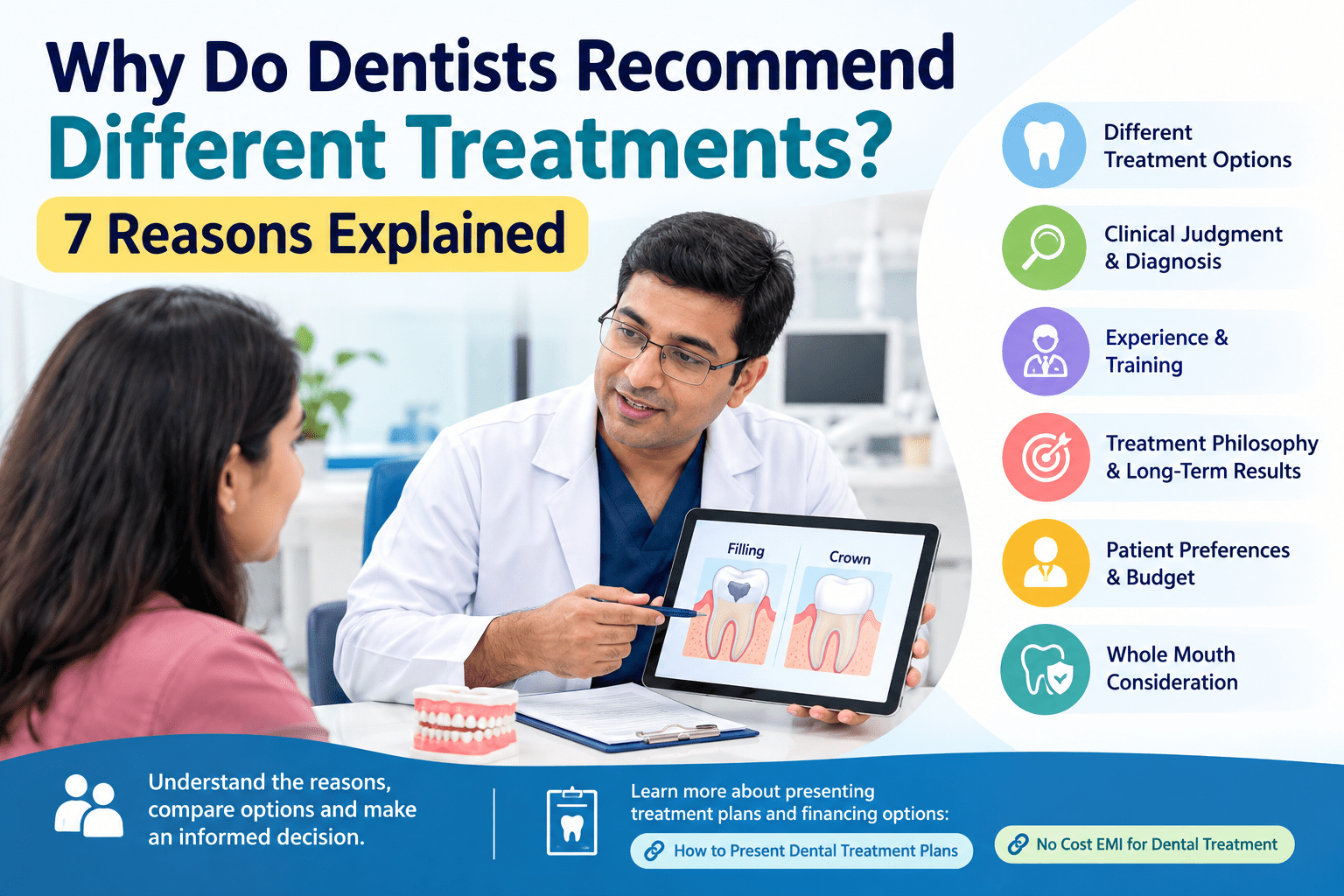
For example, depending on the condition of a damaged tooth, one dentist may recommend a filling, while another may discuss a crown or another restorative option. Similarly, a missing tooth may potentially be replaced using an implant, bridge or removable denture.
The important question is not simply “Which dentist is right?” Instead, patients should understand why each treatment has been recommended, what the advantages and limitations are, and what may happen if treatment is delayed.
7 Reasons Why Dentists Recommend Different Treatments
1. The Same Dental Problem Can Have More Than One Treatment Option
Not every dental condition has only one possible treatment.
For some patients, a conservative approach may be appropriate. For another patient with greater tooth damage, the dentist may recommend a more extensive treatment.
For example, depending on the clinical condition, treatment possibilities for a damaged tooth may include:
| Situation | Possible Treatment Approaches |
|---|---|
| Small or moderate cavity | Filling or restoration |
| Heavily damaged tooth | Crown or other restorative treatment |
| Infected tooth | Root canal treatment and restoration |
| Missing tooth | Implant, bridge or denture |
| Early or uncertain problem | Monitoring and preventive care |
These are only general examples. The appropriate treatment depends on an individual examination and diagnosis.
Therefore, receiving different options does not automatically mean that one dentist is making a mistake.
2. Dentists May Interpret the Clinical Findings Differently
Treatment planning involves professional judgment.
Two dentists may examine the same tooth and interpret factors such as tooth structure, cracks, existing restorations, gum condition, bone support or infection differently.
Diagnostic information can also influence the recommendation. A clinical examination, intraoral photographs, X-rays and, when indicated, additional imaging may provide different levels of information.
This is one reason a treatment plan should be based on the complete clinical picture rather than only the symptom that brought the patient to the clinic. Read a useful article on Dentist Advice- Oral health is important to Prevent Multiple Health issues.
3. Experience and Training Can Influence Treatment Recommendations
Dentists have different educational backgrounds, clinical experiences and areas of expertise.
For example, a dentist with extensive experience in a particular procedure may be comfortable recommending that approach in a suitable case. Another dentist may prefer an alternative treatment based on their training and experience.
This does not automatically mean that one dentist is better than another.
It means that dentists may have different clinical perspectives when several treatment options are possible.
4. Dentists May Have Different Treatment Philosophies
Some dentists generally prefer a conservative approach, focusing on preserving as much natural tooth structure as possible.
Others may take a more proactive approach and recommend treatment earlier when they believe it could reduce the risk of future complications.
Neither approach should automatically be considered right or wrong.
The appropriate decision depends on the individual clinical situation, prognosis, risks and benefits of each option.
5. Long-Term Prognosis Can Change the Recommended Treatment
A dentist may not only consider what will work today. They may also consider what could happen several years from now. Read a useful article on a Dentist recommend for Dental Crown after Root canal treatment for long term prognosis.
For example, a treatment that is less invasive today may require additional treatment later. Another approach may involve more treatment initially but potentially provide greater durability or predictability.
When comparing different dental treatment plans, ask:
- What is the goal of this treatment?
- How predictable is the result?
- How long might it last?
- What maintenance will be required?
- What could happen if the treatment fails?
- What are the alternatives?
These questions can help you understand why dentists may recommend different approaches.
6. Patient Preferences and Budget Can Influence the Discussion
Treatment planning is not only about the tooth. It is also about the patient.
Patients may have different priorities.
One patient may want the most conservative option. Another may prioritize long-term durability. Someone else may be more concerned about treatment time, appearance, number of appointments or affordability.
Therefore, dentists may discuss different treatment options depending on the patient’s needs and circumstances.
However, financial considerations should not replace proper diagnosis and clinical decision-making.
Patients should understand the clinical purpose of each option before comparing prices.
7. The Dentist May Be Thinking About the Whole Mouth, Not Just One Tooth
A dental problem rarely exists completely in isolation.
A dentist may consider:
- Other damaged teeth
- Gum health
- Bite and chewing forces
- Missing teeth
- Oral hygiene
- Existing crowns or restorations
- Previous dental treatment
- Future treatment requirements
This broader view can change the recommended treatment plan.
For example, treating one tooth in isolation may produce a different plan from planning treatment for the entire mouth.
Why Treatment Cost Can Be Different Between Dentists
Patients often become concerned when two dentists recommend different treatments and the prices are also different.
However, a higher price does not automatically mean better treatment, and a lower price does not automatically mean poorer treatment.
The cost can vary because of:
- Different procedures
- Different materials
- Laboratory charges
- Treatment complexity
- Number of appointments
- Specialist involvement
- Technology used
- Follow-up and maintenance requirements
Instead of asking only “Which treatment is cheaper?”, ask “What exactly is included in each treatment plan?”
This gives you a much better basis for comparison.
How Should You Compare Two Different Dental Treatment Plans?
If two dentists give you different recommendations, ask both dentists to explain the following:
- What is the exact diagnosis?
- Why are you recommending this treatment?
- What are the alternative treatments?
- What are the advantages and disadvantages of each option?
- What are the risks of delaying treatment?
- What happens if the recommended treatment fails?
- How many appointments are required?
- What is the expected long-term maintenance?
- What is the total estimated cost?
- Which option would you recommend and why?
A clear explanation can help you understand the reasoning behind the recommendation.
For dentists, presenting these alternatives clearly is also an important part of patient communication. You can learn more about how to present dental treatment plans to patients.
Should You Get a Second Dental Opinion?
A second opinion can be useful when you are uncertain about a treatment recommendation, particularly when:
- The treatment is expensive
- The treatment is irreversible
- Tooth extraction has been recommended
- A complex procedure has been suggested
- You have received significantly different recommendations
- You do not understand why a particular treatment is necessary
A second opinion should not simply be about finding a dentist who gives you the answer you prefer.
The goal should be to understand the diagnosis, treatment alternatives, risks and expected outcomes.
What If the Recommended Treatment Is Expensive?
Cost can sometimes become a barrier even when a patient understands the clinical need for treatment.
If affordability is the main reason for delaying treatment, ask your dental clinic whether suitable payment or financing options are available.
For Indian patients and dental clinics, you can learn more about No Cost EMI for Dental Treatment and how EMI arrangements may help manage the cost of higher-value dental procedures.
Remember that financing availability, eligibility, charges and terms can vary between providers.
Different Treatment Plans Do Not Always Mean One Dentist Is Wrong
So, why do dentists recommend different treatments?
The answer is that dental treatment planning often involves more than simply identifying a problem and selecting one fixed solution.
Different recommendations may result from:
- Different clinical interpretations
- Different diagnostic information
- Dentist experience and training
- Treatment philosophy
- Long-term prognosis
- Patient preferences
- Overall oral health
- Cost and practical considerations
Two treatment plans can therefore be different while still being based on reasonable clinical considerations.
The best approach is to understand the diagnosis and ask your dentist to explain the benefits, limitations, risks, alternatives and expected long-term outcome of each option.
Final Takeaway
If two dentists recommend different treatment plans for the same dental problem, don’t panic. Different treatment recommendations do not automatically mean that one dentist is wrong.
Ask questions, understand your alternatives and consider a second opinion when the decision is complex or irreversible.
Most importantly, don’t choose a dental treatment solely because it is the cheapest or most expensive. Choose after understanding why the treatment is recommended and how it fits your individual dental needs and long-term goals.
This article is for general educational purposes only and does not replace an examination, diagnosis or treatment recommendation from a qualified dental professional.
